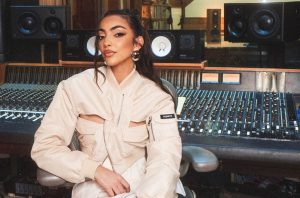
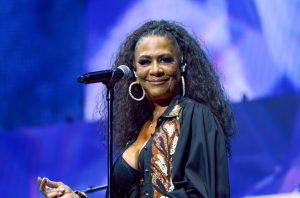
The first week of last November was bittersweet for funk instrumentalist and producer Alissia. On Sunday, Nov. 3, Quincy Jones passed away at age 91, and his life’s work of producing ingenious and timeless music made him one of Alissia’s biggest musical inspirations. But on Friday, Nov. 8, the Recording Academy announced the 2025 Grammy nominations, and Alissia became the ninth woman in the show’s 67-year history to be up for producer of the year, non-classical. She’s in great company: Janet Jackson, Mariah Carey, Sheryl Crow and Lauryn Hill are a handful of the other women who’ve been up for the honor, which has never been won by a woman before. And her competition this year includes fellow first-time nominees Mustard and Ian Fitchuk, while D’Mile is nominated for a third consecutive year and Daniel Nigro for a second. Alissia’s credits during this eligibility period include tracks by Rae Khalil, BJ the Chicago Kid, Jamila Woods and Lion Babe. She also worked on the Anderson .Paak and SiR-assisted “Do 2 Me” from Kaytranada’s Timeless album, which is nominated for best dance/electronic album, as well as “MoreOfIt” from NxWorries’ Why Lawd?, which is up for best progressive R&B album. “This nomination is so inspiring,” she tells Billboard. “I’ve been dedicating my whole life to music for 14 years. I’ve been working behind the scenes. Sometimes, it can be hard to keep going because this industry is not the easiest. You face a lot of challenges [like] stepping into rooms where I’m the only woman in that room. It took a long time for me to gain that respect.” The Swiss-born, Italian-raised musician (real name Alissia Benveniste) has remained dedicated to reviving ‘70s funk for over a decade. She moved to the United States when she was 18 to study at Boston’s Berklee College of Music, and HuffPost touted the budding bassist as “the future face of funk music.” She fronted her own band, Alissia and the Funkateers, and dropped her 2016 EP Back to the Funkture, which she’s since removed from the internet to make way for her proper debut project. Over the years, Alissia has worked with Bootsy Collins – co-writing a third of his 2017 album World Wide Funk album – Calvin Harris, Mark Ronson, Nile Rodgers and many more. She earned her first Grammy nomination – for album of the year, no less – with the deluxe edition of Mary J. Blige’s Good Morning Gorgeous after earning writing and production credits on the track “Love Without the Heartbreak.” Now with her own major Grammy nod, Alissia will continue to make a name for herself by releasing her first full-length album later this year. “People like Sabrina Carpenter, Chappell Roan, Charli XCX – they’ve worked for years and years and years, and now they’re having their moment. I’m loving that for these boss ladies,” she says. “I see a lot of DMs from young girls or women who are like, ‘I’m giving up. This industry is so hard to navigate.’ We really have to empower each other.” Billboard chatted with Alissia about her historic Grammy nomination, upcoming debut album, Prince’s Twitter DM about her cover of The Times and Bootsy Collins’ advice from their “life-changing” sessions. What kind of music did you grow up listening to, and how does that inform the music you currently make? My mom always had music playing around the house – lots of Motown stuff, Stevie [Wonder,] Earth, Wind & Fire. The moment I really, really clicked with music and was like “OK, that’s what I wanna do” is [when] I was in high school and I was heavily listening to Prince, Michael [Jackson]. Then when I moved to Boston, that’s when I really dove into all the ‘70s stuff, like funk soul, James Brown, P-Funk, The Brothers Johnson and Stevie again, but hearing it from a musician’s perspective. I feel like the love kept growing and growing, and it’s really what made me want to pick up the bass. I was like, “Oh, I want to play these basslines I’m hearing on all this Bootsy stuff and funk records.” What was the first song you learned to play on bass? “Good Times” by CHIC, but at the same time, it was also “The Payback” by James Brown. Those were the first two basslines, I kept going back and forth. It’s crazy because a year later, I’m in front of Bootsy Collins and Nile Rodgers, and they’re breaking down how they came up with it. What instruments do you play? I can get around on pretty much everything. Bass was my main instrument for a long time. People don’t even know I started on piano ‘cause I’m not prolific now, but keys is a safe space for me. I know how to edit myself on drums and guitar, I can get around synths. Around that same time I was digging into all those records, I was really inspired by what I was hearing and learning all the parts. How did you become so fascinated by the ‘70s era of music, considering you’re not a ‘70s baby? The richness of the music. A lot of times, I would go into sessions and people would be referencing songs from that era, [so] it made me dig deeper and deeper. The musicianship of it and the production is so outstanding. And it’s timeless. One of my favorite albums from Michael, Thriller, came out 40-plus years ago, and we still listen to that album nowadays to reference or take inspiration from. And that’s something I always try to aim for – making timeless music that 40 years from now, people would still listen to it. One thing Bootsy told me, and I really, really keep it close to my heart now, is: Don’t follow the trend, set the trend. Prince reached out to you after he saw your YouTube cover of one of The Time’s songs. Which song did you perform, and what did he have