

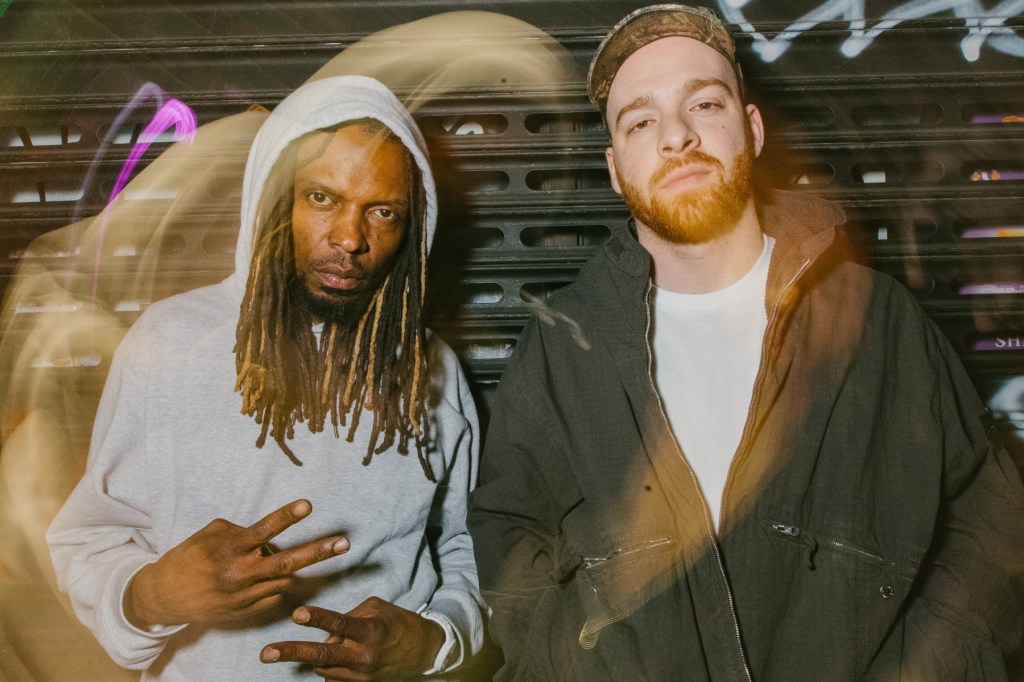
Back in 2002, Rosco P. Coldchain had a couple scene-stealing features on the Clipse’s debut album Lord Willin‘ where the then young North Philly rapper held his own next to guys like Jadakiss, Styles P and Ab-Liva on the tracks “Cot Damn” and “I’m Not You,” before his promising career was cut short due to legal troubles. He was signed to Pharrell’s Star Trak imprint and was supposed to drop his debut Hazardous Life, but it was eventually shelved after the subsidiary left Arista for Interscope during the early 2000s. Then in 2008, he was arrested for his connection to a fatal shooting (he still maintains his innocence) and spent the next 14 years in prison.
Explore

See latest videos, charts and news
Now, back home for about three or four years, Coldchain is picking up where he left off. He’s dropped music since being back outside, but fans got excited when it was announced that he would be doing a tape completely produced by underground darling Nicholas Craven, whose distinct sound has become a fixture in that scene, and has led to critically acclaimed projects with Boldy James, Tha God Fahim and Ransom. The Montreal producer’s penchant for finding and flipping unique samples into loops is the perfect backdrop for the North Philly rapper’s oft-kilter reality raps, and their most recent tape certainly didn’t disappoint. Featuring Malcolm Kamal, Jimmie D, Bruiser Wolf and Ab-Liva, Play With Something Safe puts ‘Sco’s elite lyrical ability and Craven’s versatility on full display.
We caught up with the dynamic duo over Zoom a couple weeks ago to talk about their new found chemistry, Rosco’s journey to get to this point, their process and the importance of being independent during the digital era.
Check out our convo below.
Rosco, I watched an interview you did that went up a couple days ago. You were saying that you’ve been working to get to this point since you came home about three and a half years ago. Can you talk about that journey? Because you were putting out music here and there.
Rosco P. Coldchain: I was, but I don’t think it was landing quite how I needed it to land — simply because, to be honest, I think a lot of people just didn’t know I was here. And so outside of them not knowing I was here, I was still trying to come up with a real sound. And so, long story short, couple of my comrades kept bringing up Nic Craven. I wasn’t super acclimated on how many artists and things of that nature, but I was familiar with the sound, and so I reached out and told him, “Hey, bro, I like you a lot. Can we work?” And the rest is history.
When you say sound, do you mean production wise?
R.P.C.: Yeah, in terms of the production because when I come home, I experimented it a little bit, and in all actuality, I liked all the stuff that I did. But I do know that people wanted to hear me with a specific type of sound and a specific kind of producer and he fit the mold.
I was gonna bring up that people were introduced to you through Pharrell and Craven’s style may not be as unorthodox as Pharrell’s was during that time…
R.P.C.: I feel like it, though.
It’s unorthodox in a different way. It’s soul samples and loops while you’re kind of riffing like a jazz musician.
R.P.C.: No doubt, because that’s the uniqueness of what Nick has. He does what we’re accustomed to in terms of sampling soulful sounds, right? What we’re not accustomed to is hearing it by itself and having someone rap over that, as is. He created a lane. So, my whole thought process was, “I want to be the best at this f–king lane, period.” I want to be the most proficient guy he’s worked with in that lane, and that’s who this album is.
You still in Philly?
R.P.C.: I don’t live in Philly, but yeah.
How’s it been being back home, man?
R.P.C.: Well, my son’s prom was yesterday, so I’ve been blessed to be able to see my kids graduate and go off to prom and things like that. So, I think that’s the biggest blessing out of all this s—t. I’m seeing my kids do the things I ain’t never do.
How did you react when Rosco first reached out?
Nicholas Craven: I think the first thing I did was hit up Jimmie D and was like, “Yo, guess who f—king just hit me up.” I wasn’t just familiar with Rosco, I was a fan. He didn’t have a lot of songs that I knew of, but the ones… I thought this guy was gonna be the next big thing, and then everything happened. I remember playing “I’ma Kill This” and “Box Full of Bullets.” That’s the name, right?
R.P.C.: Yeah, “Box Full of Bullets.” Hit-Boy did that.
N.C.: I just remember getting those joints off LimeWire and having them in my iPod. Growing up as a French kid in Canada, I didn’t have a lot of friends that were too knowledgeable about hip-hop, so Rosco was one of those guys that was like “my guy” that nobody else knew ,that I would listen to and I would try to put homies on, and it was too advanced for them. And I’d be like, “F–k you guys, I’m playing this s—t myself.” It’s kind of like a new version of what I did with Ransom when he came of retirement and we did something — but this is even more extreme, because Rosco didn’t retire, he got taken out of the game.
So to have the opportunity to be the guy to, not only bring him back in a way and give him the soundscape he needs to do what he needs to do, but also kind of do his first….This is your first acclaimed project since being back I think, right? Because it’s not your first project since getting out, but I feel like this has some real legs on it.
R.P.C.: Yeah, yeah, without a doubt.
It fired up the audience that you have. I mean, you’re talking to Billboard because of it.
N.C.: Exactly. And me, as a fan — it’s kind of an interesting thing — but like as a fan, the main goal was to make Rosco apart of this scene, so that other rappers and producers want to work with him. He’s now part of the ecosystem of this scene that needs good rappers like him to keep thriving. So to add a new guy into this scene, to bring back a rapper that I love, there’s so many things that this album is accomplishing that just bring me so much pride and so much joy.
It’s funny to say, because, you know, as a fan, I almost wish somebody else did this instead of me, because I can’t enjoy the album as much as any other person because I’m so invested in it. I can’t really listen to it with the ears of a fan as much. I want this to end up getting him a Pete Rock tape, or a Daringer or a Roc Marciano one. Then I’ll be have new songs to put on my iTunes that I can actually listen to. That’s the ultimate goal.
Rosco, you said something interesting in this other interview I was watching where you mentioned that there’s no underground anymore. But guys like Craven, the Alchemist, Westside, Marci built up this ecosystem outside of the mainstream where their independent and making a living. So I’m interested in how you’ve been able to adapt because before you got locked up, you essentially needed a deal to get on.
R.P.C.: I feel like I was always a hustler, so that was the first thing to understand. Hurry up and wait is not an option because when I came home, you know, you kind of expect certain s—t, right? You kind of expect certain people to do certain things, and when it’s not done a lot of people who come home, they kind of digress and revert back to old behaviors. My whole thing was understanding that the independent market was the place for me, because I like to be my own boss. I like to put out my own music at its own price, and I want to feel that my art is appreciated by the people that truly appreciate my art.
A lot of these labels, they’re just doing a job, so you ain’t nothing but a budget. And they’ll give it to you like they’re helping and all of these different things, but it’s only up until the point that your s—t fails, when you realize and you’re like, “Yo, I need help. Remember I’m the guy that you took the $20,000 from on the budget, right?” And these guys look at you and wave you off, that’s when you understand like, “Oh, this s—t was just music.” So, the people that I do things with now — not saying that in the sense of business, that it isn’t that — but I still can gauge who are good people to deal with. I’m more experienced and seasoned now. So, I just want all my money and that’s just real simple. [Laughs.]
Do you feel like you’re making up for lost time?
R.P.C.: I feel like I’m an act of revenge, if you want to be totally honest. I never got my shot how I was supposed to get it, and then by the time that I felt like I was getting some type of hold in 2011, where I started going up to New York City and seeing Premier and doing records and stuff like that, I went to jail. Because you got to remember, before I went to jail, my deal was f–ked up over at Star Trek/Interscope. It was a lot of s—t going on.
N.C.: Yeah, the Arista s—t closing down.
R.P.C.: The Arista s—t fell, then we merged with Interscope, who had a s—tload of problems going on over there, and I was signed to a f–ked-up deal. And so once we got to that understanding, it was kind of too late. I was still trying to hold on and maintain my name. I gotta still keep going, you know? So, I’m calling DJ Premier, I’m calling certain people in the industry — Steven Victor, who was an intern at that time. I’m talking to these guys regularly, like, “Yo, I gotta get out of this situation, because Philly’s gonna kill me.” Then I don’t think they understood that it was that serious until it happened.
And it’s funny how people will help you once you’re in a f–ked-up jam — but when you’re out of the jam and you’re asking them for help, nobody seeing it. And it’s just like, “I’m over this industry” s—t. So, I found a real guy in Nic.
This might be the perfect era for a rapper like you.
R.P.C.: Perfect for me, bro.
N.C.: The way I see it is that it used to be that the underground and the mainstream were two different places, like physical locations almost. It was like, you’re either signed and you’re in the stores and they’re selling your CDs, or you’re not signed and you’re going hand-to-hand out the trunk, and you might blow up. You might become C-Rayz Walz or Non Phixion, or MF DOOM, but you’re not mainstream, right? And there were people in the underground, they were kind of trying to do a mainstream sound, and there was people in the mainstream like Wu-Tang that first brought the underground grimy basement grimy mixtape sound to a commercial audience, right? And that’s the old school.
But now, it’s not two locations anymore. We’re all on streaming, we’re all in the same stores, we’re all in the same place. So today, mainstream and underground are two different mentalities. It’s two different artistic approaches, and it’s two different business approaches. Everybody I know in Montreal, none of them are known, none of them are very popular, but they’re all trying to do commercial music, and they’re not doing anything with it. Whereas me, I’m doing underground music, but I’m doing my thing, you know? It’s literally just a different hustle. Before, if you were mainstream, you were making more money than the underground. Today, you can work the underground to make more money than an artist that’s doing mainstream music.
R.P.C.: And that’s because, if you think about it, the labels have infiltrated so much on the dollar point of every artist that it’s essentially… you can never be able to get a really good deal from a label unless you’re already doing something. They want you to already be doing numbers before they even invest, and by that time I’m already making the money I’m supposed to make! All I need is $30,000-$40,000 and I’ll be a millionaire. It’s no more label. You’re your label.
With the advent of social media and the Internet, it’s much easier to go direct to consumer. You rather have engaged fans that are going to go to your shows, buy your vinyls and buy your merch because you’re not making anything from streaming.
N.C.: Yeah, exactly. Back in the days it’s either you’re on the label and they’re selling your s—t and that’s your platform, or you’re not on a label and you had to have a car and sell out of your trunk. That was your platform while going up against a whole corporation.
R.P.C.: When we were doing this back in the day in ’02-’03, everything was out the trunk. Street teams was still the s—t. We was running around ripping down n—as posters and putting up our posters. We had flyers. It was competition and being a hustler, that was the whole fun part. It was like, “Yo, we gonna kill ’em with these posters, it’s gonna be crazy.” There was actually something tangible. If somebody wanted to, they could just walk up to a wall and tear it down. You had CDs. That was a beautiful time for me.
N.C.: Today, it’s just easier to compete with the majors. We’re all using social media. Before you had to put your s—t on a billboard or on a poster and stick it in the street for people to know. Now, all you got to do is take a picture and post it on your phone and write something, and there you go. Everybody’s alerted about your release. It was real work to get your s—t known about. Today, you can do any sound you want, and if you got the hustle, you can take over.
How did the production come together for for the tape? Did you have a pack ready for him or did you craft them around his style?
N.C.: I’m always making beats. I’m just always stacking beats. Yeah, the format is usually the same, but there is a lot of variety in the instrumentation, the genre that I’m sourcing from, the tempos, the rhythms. If you’re really listening, there’s a lot of different stuff that’s happening. So, I just try to keep a lot of variety when I approach a new rapper that I haven’t worked with before. I don’t like sending a pack out because I would have to send 400 beats. I want to make sure that the artist I’m working with has the most things to choose from.
For some people, it might be too much to choose from almost like when you look at a menu when there’s too many things on it. But certain artists can really focus in onto what they’re looking for, and they’re going to maybe skip through 300 beats and just listen to two seconds of a beat, and we’ll get one of the best songs we could ever make. That’s why I’m lucky to be acclaimed for having a lot of chemistry with the artists I work with. I think it’s because of that method and that approach. I like to pull up and meet face-to-face, and I let the artist go on my laptop and click “Next” on my iTunes. I got all my beats organized on there chronologically by month and year, going back like 20 years almost.
The first thing we did, though, was get on the phone. I played him some right off the computer and we made a pretty good pack that had a lot of weird beats. One of those was the beat for “The Future,” and it’s from a Senegalese psychedelic rock album from the ’70s that I paid like 300 euros for in Belgium. The song with Bruiser Wolf is a punk rock song that I sampled. Half of the album we did remotely, and then the other half we met in Vermont, and everything was re-recorded in Vermont — but we also made a bunch of new songs, and one of those was “Benz Sprinter.” That was one of the beats I made while getting ready to go to Vermont to meet Rosco for the first time. I was thinking, “Okay, I’m going to Vermont, let’s go dig, let’s go buy some records., let’s go make some beats.”
R.P.C.: That was one of them ones, man. Soon as you heard it, you knew what it was. I had to use that for the intro.
How old are some of these raps on the tape? Do you have a bunch in a notebook?
R.P.C.: Yeah, I got a lot of it in my notebook, but I crafted at least two to three of those records offhand. The majority of it was straight out the book. A lot of those verses are years old. We’re talking at least 10. Nicholas Craven Straight out the books. Plural. [Laughs.]
Were you able to write when you was locked up?
R.P.C.: I didn’t write up until I went upstate, until I got my time. I didn’t write a single rhyme for at least six years. After the sixth year, I got my time, and I went upstate. I was little bit more in tune to write because I felt more comfortable with knowing my sentence. It was like, “Okay, I got a chance,” so that’s when I started writing.
So, why Vermont? When I first heard that, I wondered if you guys posted up in a bed & breakfast.
N.C.: Honestly? Because we’re right there. I usually go to Atlanta, Detroit or New York to work with artists. I would’ve liked Rosco to come to Montreal if it would’ve been possible. Montreal is like a 45-minute drive. It’s a bit further for him, but I feel comfortable there, and I felt like he would feel comfortable there too. I drove there with Jimmie D because I knew he was going to be hype. That’s like my right-hand man. He’s just the guy helping me call my shots behind every kind of move I do. He’s like my older brother. He helps me see the s—t the way it should be seen sometimes.
Yeah, he’s on “Die Slow” with Ab Liva.
N.C.: Yeah, and he didn’t come down to rap. He didn’t talk about his rap once. Him and Rosco were talking about his trucking company, and at one point, Rosco looked at him and was like, “Yo, I know you rap.”
R.P.C.: We had already spoken about Jimmie a long time ago, so I remembered everything essentially through other conversations. Jimmie didn’t know that I knew a lot at this point. I know Jimmie’s a real one, for real for real, so I knew he was going to give me a different perspective of a Canadian rapper. He’s going to give this album texture and he did just that. He explained the streets of Montreal, he explained his crew and what he was doing… you could feel the authenticity in what he was saying. So, it was like, “S—t, d–n, keep that.”
Was AB in the studio with you guys or you sent that off to him?
N.C.: Well, basically, I just told Rosco, “Look, we need Ab on the tape.”
Listen, that verse is crazy.
N.C.: The whole tape was recorded in Vermont, except for the track “Frankenstein,” and then we got Liva to add a verse, and that’s it.
How long were you guys out there for?
N.C.: We were out there for two days. We got a little Airbnb house, set up a studio with a mattress.
Okay, so you brought the studio with you, essentially?
N.C.: Exactly. We just brought the s—t over the border, I had my little mics set up, and we just had it rocking. It was great. He came through and we literally just recorded non-stop. He had five notebooks and a stack of paper, and he would find a beat and be like, “Okay, wait, I got something for this,” go in the papers try to find it after like 10 minutes, and then drop the verse. He’d do these in one take, and when we would do another take just in case, he would rap it exactly the same, and it’s like, bro, how do you remember the rhythm of your flow? You don’t even remember which page it was on. You had to look for it for 15 minutes. How do you remember exactly how to rap it? You didn’t even write it to this beat. Like, the s—t blew my fucking mind.
Rosco, your style early on felt like spoken word. How did you develop that flow? Were you a reader as kid? Did you write poetry? That’s why you always stood out on those Clipse records to me.
R.P.C.: I was an avid reader. I’ve read an entire Encyclopedia Britannica one time, and remembered a lot of it. My mother used to test me on stuff like that, so I think I developed that style through reading. And when I would be in group homes, you know, little institutions and s—t like that, I would write. But I remember as a young man, I used to read the Daily News, and one of the older staff members came up to me and said, “You know, that’s written on like a fifth-grade reading level?” As if to say, that’s nothing to read. You need to read like a Wall Street Journal or something like that.
So I began reading The Philadelphia Inquirer. I then woke up one day — I’ll never forget it — and s—t got weird. As I’m reading the paper, it’s was like I was rhyming, and I’m starting to notice I can read something just as plain as day that could be right there, as long as it’s a long enough paragraph, and I’ll find the syllables or other another word to make those words rhyme. Whether it’s two sentences down, four sentences down, it’s going to rhyme.
So, it was just a way that your mind worked.
R.P.C.: So, now I began to write like that. If you notice, in all the earlier s—t, I wouldn’t rhyme until maybe five, six lines down, because I was literally just writing. And so what happened was, when I went upstate, I just honed it because I knew that for a lot of people thought it was some of the most futuristic s—t in the world. But I still wasn’t writing and learning and understanding cadences completely, so once I started to understand melody and cadence is when I finally began to master my craft.
You feel like you’re a better rapper now than you were back then? Because it sounds like you didn’t miss a step.
R.P.C.: Hell yeah, I’m better. You know what’s crazy? I respect that, thank you, and I get where you’re coming from, but people never knew what I had. You only got a little bit. I was unable to give anybody anything because I was too deep in the street. Now, I’m not even in the street, because I’m a gentleman of a particular age — so I can give you these experiences, and I also can give you the full understanding of how I write. So, when people say, “Ah, man, this sounds like classic ‘Sco,” you don’t even know what classic ‘Sco is, because you never had enough. And the stuff that I was doing then was too futuristic for most minds to understand. They just caught up.
I get that, 100 percent, because you do sound different compared to those Clipse days, so we can’t say it’s “classic ‘Sco.” I think that’s fair. It’s more like, d–n, dude is still super nice. At least that’s how I felt when I hit play on the tape.
R.P.C.: It’s like, yo, I had a gold record and didn’t even have an album. You know what I mean? I was platinum in the streets and didn’t even have an album. So for me, it was like I blew up too fast. And this was pre-YouTube and pre-social media. A lot of motherf—kers were more or less fascinated by the thug s—t, and unfortunately, it preceded the music, and it messed up a lot of relationships, a lot of deals. That’s when I really began to realize that the industry is anti that for real. They only want you to sell it. They don’t want you to live it. And once they realize you a liability, they gonna cut your ass off at the drop of a dime because there’s big money at stake. They only want you to fake it. [Laughs.] Real rap.
And you know, I did that as much as I could, but now I feel like I got a hell of a chance of making it because I’m not living it no more. And a lot of these stories, yeah, they got statutes of limitations, but a lot of s—t now I can talk about, so that’s what we doing.
N.C.: Are you guys planning on doing a follow up?
R.P.C.: Yeah, we’re going to do a follow up eventually. Nic has a lot of artists that he works with, so it gives me time to sit my ass down and deal with my business because I’m running around. I got a van service that I’m doing. Running you’re own personal business and then being a rapper at night is not easy for when those times come for deadlines and s—t like that. Bt you know, you still got to put food on the table. It’s a lot.
Right now, I’m just trying to work it up until I get to a point to where my love is my business in it’s totality and I’m making money hand over fist finally from from my work. I’m gonna try to put something out in a few months until that time comes to give the fans what they need in that sense, or hold over until me and Nic can can do it again.
So, Nic, what else should fans expect from you this year?
N.C.: I got some s—t coming with Boldy in a few weeks. Me and Rosco’s follow-up will probably be around the same time next year, but before that, we got a tape coming out. I’m producing most of it, and it’s going to be Rosco and a lot of new guys that you haven’t heard him with, and a lot of new producers that you haven’t heard him with, too. So we’re going to try to do just like a solo, solo Roscoe tape.




Comentarios