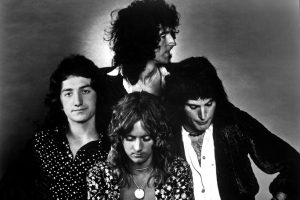
We’ll explain everything but the meaning of «Scaramouche, Scaramouche, will you do the fandango?» 9/25/2025 British rock band Queen (clockwise from top: Brian May, Freddie Mercury, Roger Taylor and John Deacon pose for an Electra Records publicity still to promote their album ‘A Night at the Opera’ in 1975. Michael Ochs Archives/Getty Images Queen’s “Bohemian Rhapsody” is turning 50. The epic single, which Queen front-man Freddie Mercury liked to call a “mock opera,” was recorded in late August and September 1975 and was released on Oct. 31, 1975. The song has long been considered a classic. In October 1977, just two years after its release, it was named the best British single of the previous 25 years by the British Phonographic Industry. The song was voted into the Grammy Hall of Fame in 2004 and the National Recording Registry in 2022. The song’s video surpassed one billion views on YouTube in July 2019, making it the oldest video to reach one billion on the platform. In 2021, the song was certified Diamond by the RIAA for combined digital sales/streams equal to 10 million units.It’s the only song from the 1970s to be certified Diamond. Two of the principals on the recording are no longer with us. Mercury, who wrote the song; sang lead, backing and operatic vocals; and played piano on the track, died in 1991 at age 45. Roy Thomas Baker, who co-produced the track (and five Queen albums in the 1970s) died in April at age 78. The other three band members are still alive and well: Brian May, who played electric guitar and sang operatic vocals on the track, is 78; Roger Taylor, who played drums, timpani and gong and sang operatic vocals, is 76; and John Deacon, who played bass guitar, is 74. Here are 14 things to know about a classic single on the 50th anniversary of its release. “Bohemian Rhapsody” was Queen’s first top 10 hit on the Billboard Hot 100. Image Credit: Paul Natkin/Getty Images It reached No. 9 in April 1976. Queen had narrowly missed the top 10 when its breakthrough hit “Killer Queen” peaked at No. 12 in May 1975. The strong showing for “Bohemian Rhapsody” came despite its unconventional style and its length (5:50). It was the longest song to make the top 10 since Elton John’s “Someone Saved My Life Tonight” (6:45) eight months earlier. The song topped the Official U.K. Singles Chart for nine weeks, the longest run in nearly 20 years. “Bohemian Rhapsody” was Queen’s first No. 1 U.K. hit. “Killer Queen” had peaked at No. 2 in the band’s home country. Its nine-week run on top was the longest since Paul Anka’s “Diana” ruled the roost for nine weeks in 1957. Improbably, “Bohemian Rhapsody,” with its opt-repeated phrase “mamma mia,” was replaced at No. 1 on the U.K. chart by ABBA’s “Mamma Mia.” Freddie Mercury wrote “Bohemian Rhapsody,” but it wasn’t his highest-charting Hot 100 hit. Mercury also wrote the rockabilly-influenced “Crazy Little Thing Called Love,” which in 1980 became the band’s first No. 1 hit. Mercury was also the sole credited author of “We Are the Champions” (No. 4) and three songs that just missed the top 10: “Body Language” (No. 11), “Killer Queen” (No. 12) and “Somebody to Love” (No. 13). The song brought Queen its first two Grammy nods, though they didn’t win either one. Queen was nominated forbest pop vocal performance by a duo, group or chorus, but lost to Chicago’s “If You Leave Me Now.” Queen was also nominated for best arrangement for voices (duo, group or chorus) but lost to Starland Vocal Band’s “Afternoon Delight.” These losses may seem like head-scratchers today, but here’s some historical context: Both “If You Leave Me Now” and “Afternoon Delight” had been No. 1 hits on the Hot 100. As noted, “Bohemian Rhapsody” had peaked at No. 9. Also, “If You Leave Me Now” was Chicago’s first No. 1 hit following 10 top 10 hits that had fallen short of the top spot. And the ballad represented a new musical direction for the group. Both the Chicago and Starland Vocal Band hits received Grammy nods for record of the year. “Bohemian Rhapsody” did not. So, the Grammy shut-out for “Bohemian Rhapsody” wasn’t considered an upset at the time, though the song is obviously considered more of a classic today than either of those other hits. As noted above, “Bohemian Rhapsody” has been voted into both the Grammy Hall of Fame and the National Recording Registry. The Chicago and Starland Vocal Band hits have yet to receive either accolade. Queen made a music video for the song, a rare move in 1975. The video was recorded in just four hours on Nov. 10, 1975. It was directed by Bruce Gowers, who had directed a video of the band’s 1974 performance at the Rainbow Theatre in London. Today, the visual is widely considered one of the most important of the pre-MTV era, and a precursor for much that would come in the music video age. A Night at the Opera was titled after a 1936 Marx Brothers movie. Image Credit: Screen Archives/Getty Images “Bohemian Rhapsody” was featured on Queen’s fourth album, A Night at the Opera. The album was titled after a 1936 movie by the legendary comedy troupe, The Marx Brothers. The band’s next album, A Day at the Races, was also titled after a Marx Brothers movie. And here, the plot thickens: A Day at the Races was the Marx Brothers’ follow-up film to A Night at the Opera. Queen could have kept this going a little longer by titling their next album Room Service, after the film which came next in the Marx Brothers filmography, but the band went with News of the World instead. The Rolling Stone review of A Night at the Opera didn’t mention its most famous track. The magazine’s review of A Night at the Opera, which ran in its April 2, 1976 issue, didn’t even mention “Bohemian