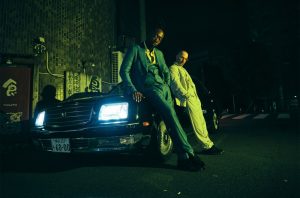
Freddie Gibbs and The Alchemist are playing the long game. Five years after they dropped their Grammy-nominated collab album Alfredo, the midwest rapper and the west coast producer decided to go bigger with the sequel by heading to Japan to give fans a short film centered around the Yakuza underworld where they run a ramen shop that launders money for organized crime figures. They had so much making and shooting Alfredo: The Movie that Freddie doesn’t want to release an album again without attaching a short film to it. Gangsta Gibbs and Uncle Al stopped by Billboard’s New York office earlier this week with a big bag of food, so that we could break bread and talk about everything from the chemistry they’ve built by working together to their love of independence to the both of them addressing rumors that range from the upcoming Grand Theft Auto game to Freddie’s alleged powwow with former collaborator Benny the Butcher to whether or not Al sent a beat pack to Future. Explore See latest videos, charts and news In short, we covered a ton of topics. The conversation picks up as we were having a conversation over some Sophie’s cuban cuisine about the type of rap music they make. Check out our lengthy, yet entertaining conversation below. Freddie Gibbs: To be honest, man, it just speaks to the longevity of what we do. This ain’t no throwback s—t. I never wanted to make this no throwback s—t. It just shows you that this type of s—t will never die if you do it correctly. I was watching your Idea Generation interview with Noah, when you were talking about how you had that success, and then the game started changing, because I feel like you’re synonymous with that East Coast sound, and for a while that sound was like dying out. Can you talk about why that sound was able to have a resurgence? The Alchemist: It did feel for a minute, not like she was dying, but like the commerce behind the whole s—t was dying. At that time, if you were doing the type of s—t we were doing — and you gotta give a lot of credit to Sean Price, he was one of the first dudes to kind of bridge this gap to where we’re at if you were doing the type of music we’re doing — people used to be like, “What’s going on down there? Y’all making any money?” There wasn’t a direct-to-consumer ecosystem that we all collectively have created in the last 10-plus years with merch, vinyl, concerts. Basically us and a couple of other people, I think in necessity being the mother of invention, and being like, “Well, this is what we doing now, f—k these labels. Let’s start doing it ourselves the way we want to do it, no pressure.” And we built a world that became profitable. We all started showing our houses, cars, and people started seeing that tripping out because it was like, “Let me hear their music. They selling drugs? What’s going on?” We created a legit ecosystem that was working, that came from us selling product directly to our fans, not compromising the sound, not doing something for radio, we built a world. And then, once we started making money, it was like people started paying attention. Money does some s—t. They heard the music the whole time, but once it started becoming successful, and they started seeing us with all the things that these other rappers got…we have real fans because we started from the ground up, so our show tickets actually sell. some of these bigger artists now, you look at their streaming numbers, you can’t book a show based on that, because those aren’t real fans, you gonna have an empty arena. Our s—t is real. When you argue about the best rappers and some people bring up sales, it’s like, who gives a f—k? Jay or somebody might bring it up on a record, but at the end of the day, it’s about the quality. It’s a factor, but it doesn’t hold as much weight as some might think. A.: That never mattered, but people respect success. Like, back in the day, they wouldn’t play wack s—t in the hood. They wouldn’t play MC Hammer. As the years changed, I remember when Nelly came out, he was dope, but he was more commercial, and they the streets playing it. They respect the money and success. And I feel like that’s one thing we had to prove with our music to get respect, they see what we doing and that it’s adding up. If y’all was working with a label, they would’ve made you put an R&B song on the album. You had to play that game. F.G.: Oh, they would’ve made us do a whole album of radio songs and we made one with out trying with the A.P. track [“Ensalada.”] A.: It’s a gift and a curse, and I thought about this recently — because we all built this world that I just described in the last 10 years by doing it our own way. F—k radio, f—k everybody. Now our tours are amazing, our s—t is flourishing, but I kind of miss the pressure. This is the flip side. In the earlier days, my biggest records come from the era when we had to push to find a way to get in the Tunnel, to get on Flex. There was a little bit of pressure we had back then, and I don’t think we ever made no bulls—t to appeal to it, but thinking now, I was talking to Roc too like damn, we built this world in our comfort zone on our own, and now I want to push us. I wanna do what the A&R’s do to ourselves because I feel like we’re on a major scale with me and Freddie just did numbers. We playing with the big boys