
Khamari Talks ‘To Dry a Tear,’ Leaving RCA & Jeff Buckley’s Influence
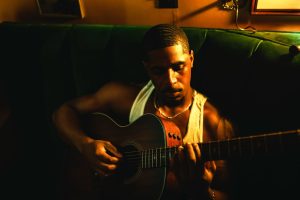
“It’s hard singing about s—t that feels sad,” says Khamari. And with buzzy, somber tracks ranging from 2021’s “Doctor, My Eyes” to this year’s triumvirate of To Dry a Tear pre-release singles comprising the bulk of his catalog, Khamari knows a thing or two about sadness. After officially debuting with 2020’s Eldorado EP, scoring an Usher placement with the R&B icon’s Marshmello-assisted “Too Much” and sharing a stream of follow-up singles, the Boston-born, Los Angeles-based singer-songwriter unleashed his debut studio album in 2023. Titled A Brief Nirvana, Khamari’s RCA Records debut announced the arrival of a new, strikingly post-Frank Ocean rising R&B star. Armed with classical training and a Berklee College of Music background, a beautifully forlorn falsetto that explores everything from existentialism to mortality and a wide range of genre-agnostic influences, Khamari primarily operates in the blues lane of R&B, while never forsaking his contemporary approach to narrative songwriting. Last winter, Khamari parted ways with RCA, citing creative differences, and joined forces with independent record label Encore Recordings ahead of his new full-length, the enrapturing To Dry a Tear. Introduced by singles such as “Head in a Jar,” “Sycamore Tree” and “Lonely in the Jungle,” Khamari’s sophomore album distills two years of life experience into 11 incredibly lush and seamlessly sequenced tracks. Across the album, Khamari gets introspective regarding withering romances, crises of faith and the frustrating allure of distance. Pulling from D’Angelo’s “Untitled” and the understated drama of Jeff Buckley, To Dry a Tear finds Khamari building on the sampling innovations of his debut, while reaching new heights as both producer and arranger. “A lot of the things I was aiming for on this project were an imperfect version of something already,” he tells Billboard. “When I listen to D’Angelo or Jeff Buckley, none of that s—t is perfect. It’s a very raw version of what they had in their head, and it’s a very musical, dramatic emotion they experienced. Trying to translate that into something today can be difficult in terms of production style, but that’s definitely something that I fought for. I don’t want it to be perfect; I just want it to be this version of imperfect.” Below, Khamari discusses crafting his sophomore LP, parting ways with RCA and the rise of rock influences in contemporary R&B. Was there a particular song that signaled to you that you were headed towards a new album? Every song is so individual in the creative process that there wasn’t one song that was [clearly] the centerpiece. There were definitely dope moments along the way, like writing “Lonely in the Jungle” and “Sycamore Tree” and “Lord, Forgive Me” and “Acres.” Those were such specific moments that I was like, “This is definitely going to be a part of whatever I do.” Who did you most closely work with to bring this album to life? My collaborators are still similar to the [Brief Nirvana cast, including production duo Trackside]. I brought in a lot of my musician homies and my music director, Q, to help me flesh out ideas that I started in my bedroom. I play a lot of keys on the album, as well as guitar. I’m also leading the production that ties everything together. I play bass on “Lonely in the Jungle” too. I had a hand in all of the parts for songs like “Lonely” and “Lord, Forgive Me,” even if I didn’t play them myself. How would you compare the experience of creating a project driven by samples to one that’s not? With samples, you have to be respectful of the [original record’s] history and context. You’re thinking about where everything came from, what it was a part of, and what it meant to other people and how it feels. With original music, starting from scratch is so dope because it’s a blank slate, and the possibilities are endless. But that’s also why it’s hard. You’re making sure the parts don’t just feel good musically, you’re also ensuring they feel tightly knit enough that they’re memorable for anyone that’s not a music head. It’s daunting to try and find a very distilled version of something that feels musical and is still very original, given that everything’s already been done. You flip D’Angelo’s “Untitled (How Does It Feel)” on “Sycamore Tree.” Is there added pressure when you’re messing with a song of that magnitude? I didn’t run into that. I genuinely try not to put out things that I don’t love. I obviously respect the history of D’Angelo and what he’s done for R&B music, so when something like that comes up, I’m like, “This is a part of my history too.” It’s a part of my inspiration and my process. I’ve listened to it as many times as my parents; it’s in my blood. I don’t feel pressure in that way — but there’s definitely that moment when you hope he or whoever is going to clear the song hears that I’m trying to pay homage. Jeff Buckley is also a major influence on this album’s sound. What drew you to his music? I’m always looking for inspiration outside of what other people who look and sound like me would be inspired by. Jeff Buckley was it for me. He came up in conversation with my manager, and I listened to him one day, and I was like, “How the f—k did you not put me onto this s—t earlier?” I love Red Hot Chili Peppers and The Strokes and alternative rock, but [Buckley] was one person I’d never heard before. There’s such drama in his music, voice, and even his guitar-playing. He plays so gently, but he’s also very aggressive in the same way that there’s drama in a Kanye album. I was able to really appreciate that and figure out how to bring some of that into what I do. What was the most difficult song for you to land on a final mix for? All of them. [Laughs.] If you ask